
The library
The library is the registry of everything a project refers to: one card per work — a paper, a book, a preprint, a dataset, a piece of software, a report of the project’s own — recording how far it was actually read, what may be claimed from it and at which page, and what the project noted about it.
It is a component of its own, with its own directory, tool, check and lifecycle: a card names no record of any other system, and whoever cites a work writes the cite prefix and the card’s key (lib:jen1990) and asks the library whether the key exists and how the work was read.
The tool is scripts/library.py of the library skill (/research:library in Claude Code), one Python 3.11 file with no dependencies: the CLI, the check, the index generator and the selftest; this page is the tool — its commands, the files it keeps, its bindings, its check and its words — and Library cards is the specification of a card.
What it does
A work is registered when it is first read or first cited, and its card records the reading: a grade that is a claim about the reader, never about the work, so a resolver’s answer, a search engine’s snippet or a subagent’s report moves no grade.
The reference list of each document the project binds is tied to the cards, so citing a work that has no card, or one graded unread without naming the work it is known through, fails the check; library citecheck ties the document’s text to its own reference entries, closing the chain from a sentence to a card.
An extract records what a work states at a named place, with the rule on what may be claimed of it, and is held to the kept copy’s text where one is kept.
Online lookups — arXiv, Crossref, OpenAlex and others — fill in a card’s fields, find open copies and watch for new citing works; they run on demand and never from the check.
The commands
| Offline | Command |
|---|---|
| a new card | library register "Title" --kind article --author "…" --year 1990 --doi … |
| how far it was read | library read KEY --grade parts --what "sections 1 to 3" |
| a dated note, an addressed extract | library note KEY --note "…", library extract KEY ID --at "Theorem 4" --quote "…" |
| a field corrected by hand, a link, a work set aside | library type KEY --title "…", library relate KEY KEY, library exclude KEY --reason "…" |
| a copy obtained by hand, its pages, its text searched | library keep KEY FILE, library page KEY, library find --text WORDS |
| search, links, citing sites | library find WORDS, library show REF, library related KEY, library cited KEY, library claims, library entries |
| a document’s citations against its own references | library citecheck DOC |
| the check and the index | library check, library index; library keys is what a consumer’s check reads |
| Online | Command |
|---|---|
| a card from a reference entry, an identifier or a URL | library resolve "ENTRY" --register, library resolve --url URL --register |
| a copy, a re-check, a lost copy back | library fetch KEY, library verify KEY, library restore |
| works citing a card, a saved query | library watch --add NAME --citing KEY, library watch, library candidates |
A card is named by its key or by any of its identifiers wherever a command takes REF; every command takes --json; library init is the write behind the setup, and library init --print-instructions prints the paragraphs for the instructions file for the bindings as they stand, writing nothing and refusing nothing; library --help lists every command and library <command> --help its flags, and neither needs a bindings file.
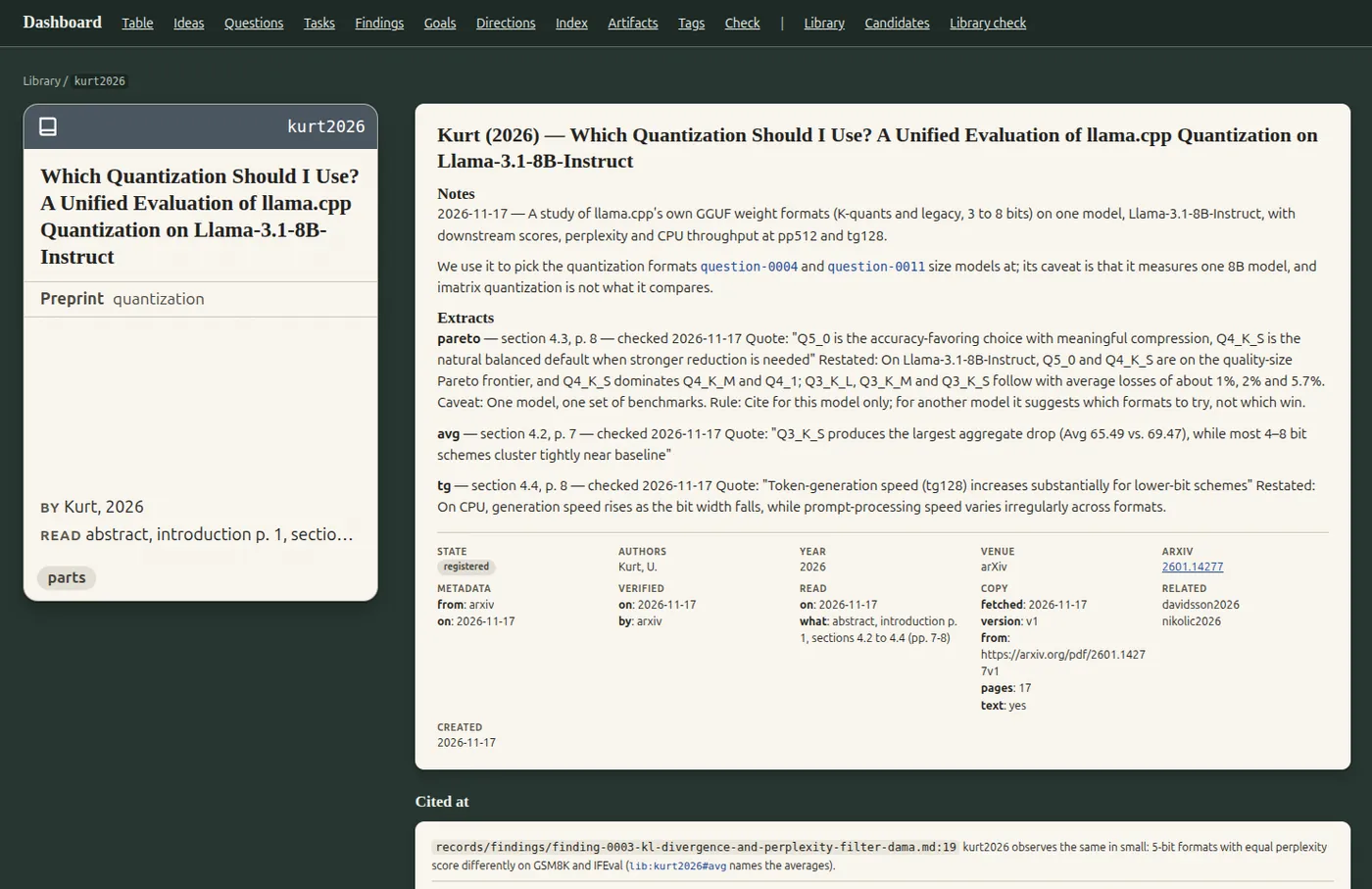
A card’s --json carries beside its fields lines, the list of {"label", "text"} pairs a card says beside its title, only the ones that hold something, in finished words: by (the authors, by surname, and the year, Jen & Lovelace, 1990, Jen et al., 1990 for more than two) and read (what was read of the work, the words library read --what wrote); library find, library show and the other commands that answer cards carry it, and the dashboard prints it at the foot of the card’s face without reading a file.
 The skill names every flag, and the kit’s tests hold it to the script.
The files it keeps
- The cards,
cards/<key>.mdunder the library’s directory, one per work; Library cards specifies them. - The index,
INDEX.mdbeside them, written bylibrary indexand never by hand, one line per card. It is generated, not prose, and a card’s line may run past a hundred characters: a project’s line-length checks leave it out, as the flow’s index is left out of the reflow. - The store, ignored by version control, holding the copies that can be fetched again with the address each came from and the derived full-text index; and the kept directory, tracked, holding the copies nothing can fetch again, which
library keepwrites only with--redistributable, since a copy there is redistributed with the repository. - The watches file and the candidates file, written by
library watchandlibrary candidates: what each watch has already seen, and the works surfaced that nobody has registered. - The documents the project binds are read and never written: each entry of their
## Referencessection is tied to exactly one card at every check.
Where a key is cited is computed from the files [cite] scan names and never stored.
library.toml
library init --kept --scan records --scan WORKLOG.md writes the bindings file at the project root, with the bindings filled in and the optional ones commented; it is the schema, with every binding explained where it stands, and the kit’s tests hold this page to what init writes.
A project whose documents cite by key alone binds no [entries] documents; a project with no reports binds no internal directories; both halves of the check then say they looked at nothing there.
# library.toml — the reference library's bindings for THIS project.  Every path is relative
# to this file's directory.  The `library` skill reads it.

[paths]
library = "library"                 # cards/<key>.md, one per work; INDEX.md, generated by `library index`
store = "library/.store"            # IGNORED by version control: fetched copies and the derived full-text index
kept = "library/kept"             # TRACKED: copies nothing can fetch again
# reflow_module = "scripts/reflow.py"   # exports reflow_text(text): one sentence per line; built-in otherwise

[card]
kinds = ["article", "book", "chapter", "preprint", "thesis", "report", "document", "web", "repository", "dataset"]

[cite]
# A work is cited by this prefix and its card's key, `lib:jen1990`.  `library cited` and
# `library related` compute the citing sites from these files and directories (*.md under a
# directory) and store nothing.
prefix = "lib:"
scan = ["records", "WORKLOG.md"]

[entries]
# The documents whose `## References` entries are tied to cards; each entry must agree with exactly
# one card.  Empty where the documents cite by key.
documents = []
heading = "References"

[internal]
# A card naming a tracked file of the project (`file`) is an internal document — a report, a survey,
# anything made here or handed in.  Every file under these directories has its card; no bound
# document's reference entry may be tied to one.
kinds = ["report", "document"]
directories = []

[claims]
# The shapes of a sentence that credits a document against a named work, as regular expressions;
# the defaults are generic — a project with a prover adds its own words (`first formalization`,
# `machine-checked`, `in any prover`).
# shapes = []

[copy]
# Prints a PDF's text with a form feed between pages; `{file}` stands for the kept copy.
text_command = ["pdftotext", "-layout", "{file}", "-"]

[find]
limit = 10
The check
Every check exits 0 when clean, 1 when it found problems, each printed with its place, and 2 when it could not run: no bindings file at the root, or one that does not parse.
The 2 is its own code so that a hook or a CI job never reads “did not run” as “clean”.
library citecheck given a file that is not there, or with no document given and none bound, exits 2 as well, and so does library check --staged outside a git repository.
library check ends with six coverage lines — the cards by grade and the copies by state, the cards a resolver wrote and the verify stamps, the internal documents, the extracts and how many a kept copy bears out, the watches, the reference entries read — so a green says what it did not look at, and that it asked no resolver; library.py --selftest plants one defect per code and fails when a code it can report is planted nowhere, and the kit’s tests hold the table below to the script.
library check
library check --staged is the same check on what a commit will hold, the git index: a temporary checkout of it (git checkout-index -a, from the repository’s top level) with the project’s counterpart as the root, the output printed with the paths shown as the project’s own, the exit code the check’s, the directory removed however it ends.
A tracked path is read from the index only, and a path git ignores, a kept copy among them, is read from the working tree, since the index holds none.
The hooks’ entry is library check --staged, because the runner sets aside the unstaged changes to tracked files and leaves the untracked ones; without the flag the check reads the working tree as before.
| Code | What it says |
|---|---|
| L0 | a card’s front matter cannot be read: it is outside the subset the tool writes |
| L1 | the file’s name is not lowercase letters, digits and hyphens, or the key is not the file’s name |
| L2 | a field is missing, unknown or of the wrong shape, a kind the project does not list, a title missing, a year that is not a number, metadata or verified incomplete |
| L3 | two cards carry the same identifier |
| L4 | a read grade is not one of the four, a read without its date or, for a work read in parts, without which parts; an ungraded card that is not seeded |
| L5 | via, related or a body citation names a card that does not exist, a related card that does not name this one back, or an extract the cited card does not carry |
| L6 | a copy without a path and a hash, outside the store or the kept directory, or not matching its recorded hash |
| L7 | a state not among the legal ones, an excluded card without its reason and date, a registered card with an exclusion |
| L8 | a date that is not an ISO date or is in the future, or a card without its created date |
| L9 | a body is not one sentence per line |
| L10 | a body that is not ## Notes then ## Extracts with nothing before them |
| L11 | the index is missing or stale — run library index |
| L12 | a reference entry of a bound document that no card agrees with, that two cards agree with, or that names an internal document |
| L13 | a work a bound document cites is graded unread and names no via |
| L14 | the watch file or the candidates file cannot be read |
| L15 | an extract the kept copy does not bear out: its quotation is not in the kept text, or its locator names a section, page or statement that is not |
| L16 | an extract is malformed — its id, locator, words, caveat, rule or date — or its checked date is not a date or is in the future, or an unread card with no via carries an extract |
| L17 | a card naming a project file whose file is not in the tree or whose kind is not internal, an internal document recording another copy, or a card of an internal kind naming no file |
library citecheck
library citecheck [DOC…] reads each document’s text against its own ## References section, the bound documents where none is given, and prints, as file and line:
- an author-year citation that no entry answers: none whose first author is the cited name, with the cited date, a letter suffix included;
- an entry the text never cites;
- a line under the heading written like an entry and not read as one, which no citation can reach.
Under --json each is a problem of code CITE; the last line counts the documents, the citations and the entries read.
It ties no entry to a card, which is library check’s L12.
What goes online
resolve, verify, fetch, restore and watch call arXiv, doi.org, Crossref, OpenAlex, the OpenCitations index, GitHub’s API and, when asked, zbMATH, Semantic Scholar and Unpaywall; they read three optional environment variables and never a file.
What goes online, and what runs lists the hosts, the variables and the limits; nothing else in the kit leaves the machine.
Words
- card — one file per referred work: its fields, how it was read, our notes, its extracts, its copy.
- key — a card’s pinned name, the first author’s surname and the year by default and an internal document’s file stem,
--keyfor another; a record cites a work aslib:<key>. - register (a work) —
library register: a new card for a work; distinct from registering a result, below. - read grade —
unread,skimmed,parts,full: a claim about the reader, not the work; a resolver’s answer is never a read. - via — the card a work is known through when it was not read itself.
- extract — what a work says at a place: a locator, the words quoted or restated, the author’s caveat, the rule on what may be claimed; cited as
lib:<key>#<id>. - copy, kept copy, the store — a work’s file: in the ignored store with the address it can be fetched from again, or in the tracked kept directory when nothing can, where it is redistributed with the repository, so
keepwrites there only with--redistributable. - resolver — an online interface the library asks for a work’s fields: arXiv, DOI, Crossref, OpenAlex and the others
docs/network.mdlists; never asked by a check. - watch — a standing look for new works citing or related to a card, run by hand, keeping what it has seen and no clock.
- candidate — a work a watch surfaced and nobody has registered, kept in the candidates file until it is registered or set aside.
- seeded — a card loaded from an older list of works rather than registered for a citation, marked so.
- internal document — a document of the project itself with a card of an internal kind naming its tracked file; cited by key, never from a document’s reference entries.
- reference entry — a line of a document’s
## Referencessection, tied to exactly one card by title, first author and year. - author-year citation —
Jen (1990)or(Jen, 1990)in a document’s text, answered by the entry of its references with that first author and date;library citecheckholds the two to each other.